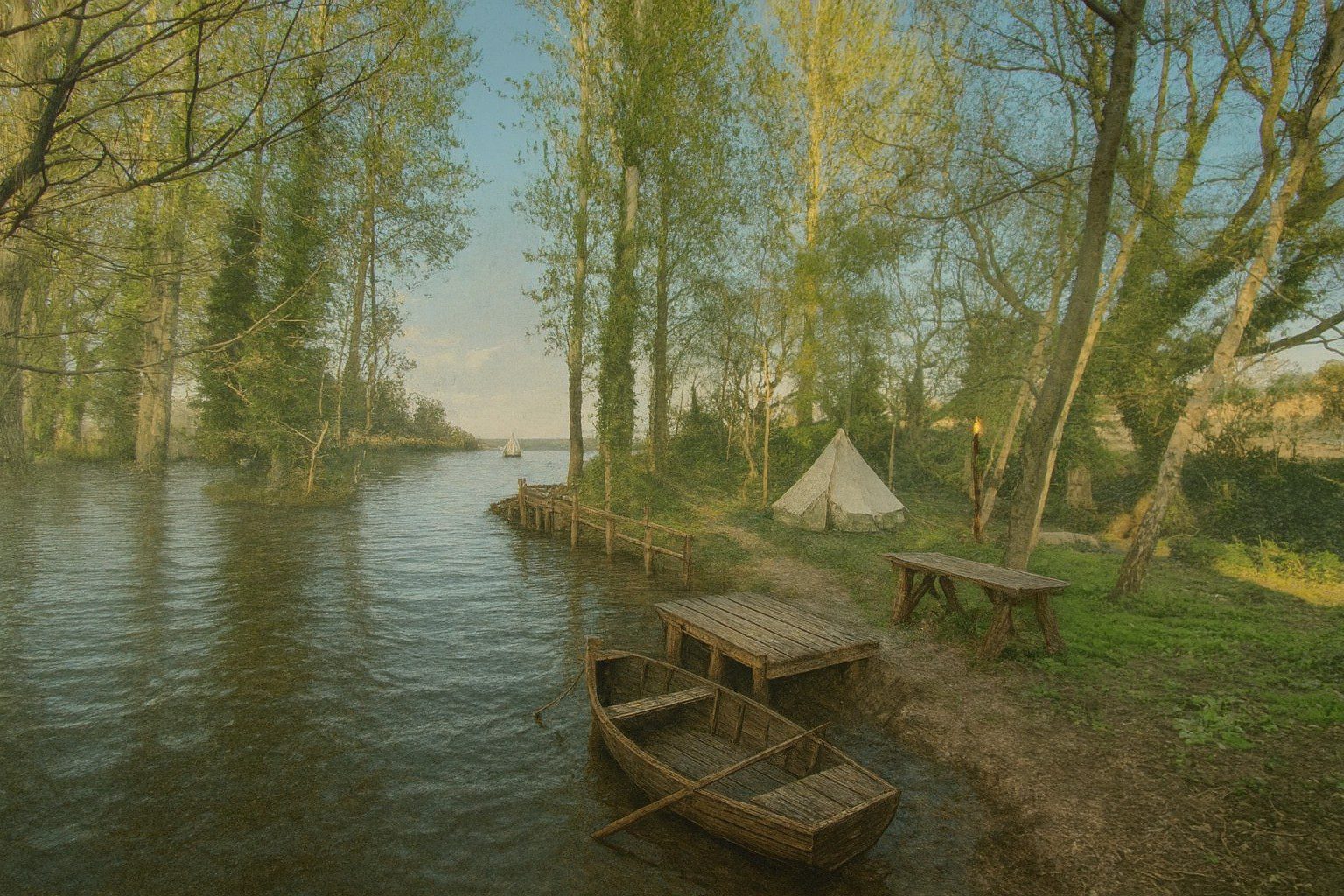

For much of antiquity and into the early medieval period, Puddledock Woods stood on the very edge of the Wantsum Channel — a wide tidal strait that once separated the Isle of Thanet from mainland Kent. In its heyday the Wantsum was up to two miles wide, providing a sheltered seaway for Roman galleys, Saxon trading vessels, and later medieval ships travelling between the English Channel and the Thames Estuary. This route was so significant that Thanet was effectively an island, and places like Reculver and Richborough became important Roman ports and defensive sites.
As the centuries passed, nature reshaped the land. Storms deposited shingle, rivers carried silt downstream, and human drainage schemes gradually transformed the landscape. By the late Middle Ages, the Wantsum had narrowed dramatically, and by the post-medieval period much of it had become fertile farmland. What was once a water highway was reduced to ditches, creeks and damp pastures, leaving behind names and traces in the landscape that tell of its watery past.
It’s within this context that the name “Puddledock” emerges in local memory. A “dock” in this sense did not necessarily mean a large harbour or quay, but a simple landing place where small boats could tie up, goods could be loaded, and people could cross from one muddy bank to another. Combined with “puddle,” the word evokes the marshy, waterlogged setting that would have surrounded the site in earlier centuries. Local tradition therefore holds that Puddledock was once a modest but useful docking point on the edge of the old channel — a link between land and water in a world where rivers and tidal straits were the main highways of trade and travel.
Today, standing among the trees and meadows, it takes imagination to picture such a watery frontier. But the Wantsum’s ghost still lingers in the straight drainage ditches, the heavy soils, and the very name of Puddledock itself — all reminders of a time when ships, rather than tractors, moved through this landscape.